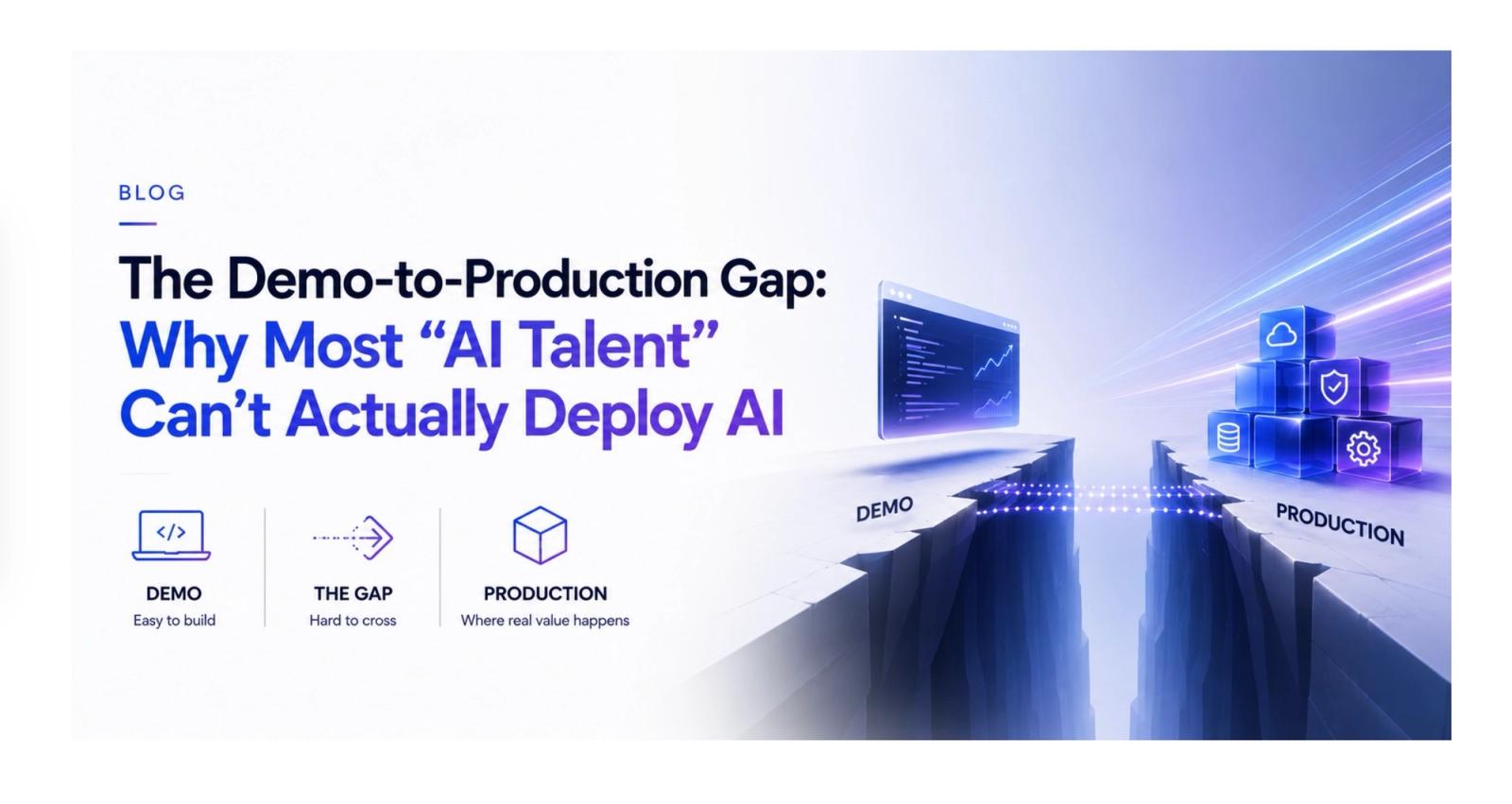
Why Your Best AI Hire Will Quit in 90 Days (And How the Fastest Enterprises Prevent It)

Aventiqo · The Human Layer of AI, Part 3 of 5
There is a failure pattern in enterprise AI that almost no one budgets for. The enterprise wins the talent war, outbids competitors, lands a genuinely deployment-grade engineer, announces the hire internally as proof the AI strategy is real. Ninety days later, the engineer resigns. Nothing has been deployed. The organisation quietly concludes that “AI talent doesn’t work here,” and the next requisition gets harder to justify.
In Part 1 of this series, we examined why deployment talent is the most contested asset class in technology. In Part 2, we showed how to assess for it. This post addresses the stage where enterprises lose the talent they fought hardest to win: the first ninety days. The uncomfortable finding is that early attrition of AI talent is rarely a talent problem. It is an environment problem, and it is almost entirely preventable.
The Formula 1 Problem
Here is the simplest way to understand what goes wrong.
Imagine a team spends a fortune recruiting a Formula 1 driver, genuinely world-class, exactly the right hire. The driver arrives on day one to find there is no fuel in the car, the garage keys are held by a department that requires a six-week access request, and the team principal is in meetings until next quarter. The driver sits in the paddock for three months, sends increasingly polite escalation emails, and then leaves for a team that actually races.
Now ask: was that a hiring failure?
This is precisely what happens to deployment-grade AI talent inside most enterprises. The engineer arrives ready to build and discovers there is no data access, no executive sponsor with the authority to unblock cross-functional decisions, no defined deployment target, and no agreement on what success even means. The skills that made the hire valuable, production stamina, business judgment, speed, have nothing to act on. And here is the part most leaders miss: the better the hire, the faster they leave. Deployment-grade engineers have options, they recognise an unready environment within weeks, and the frontier labs are recruiting them continuously. Mediocre hires stay in the paddock. Great ones go race somewhere else.
Enterprises don’t lose AI talent to better offers. They lose it to their own unready environments, and the best talent leaves first.
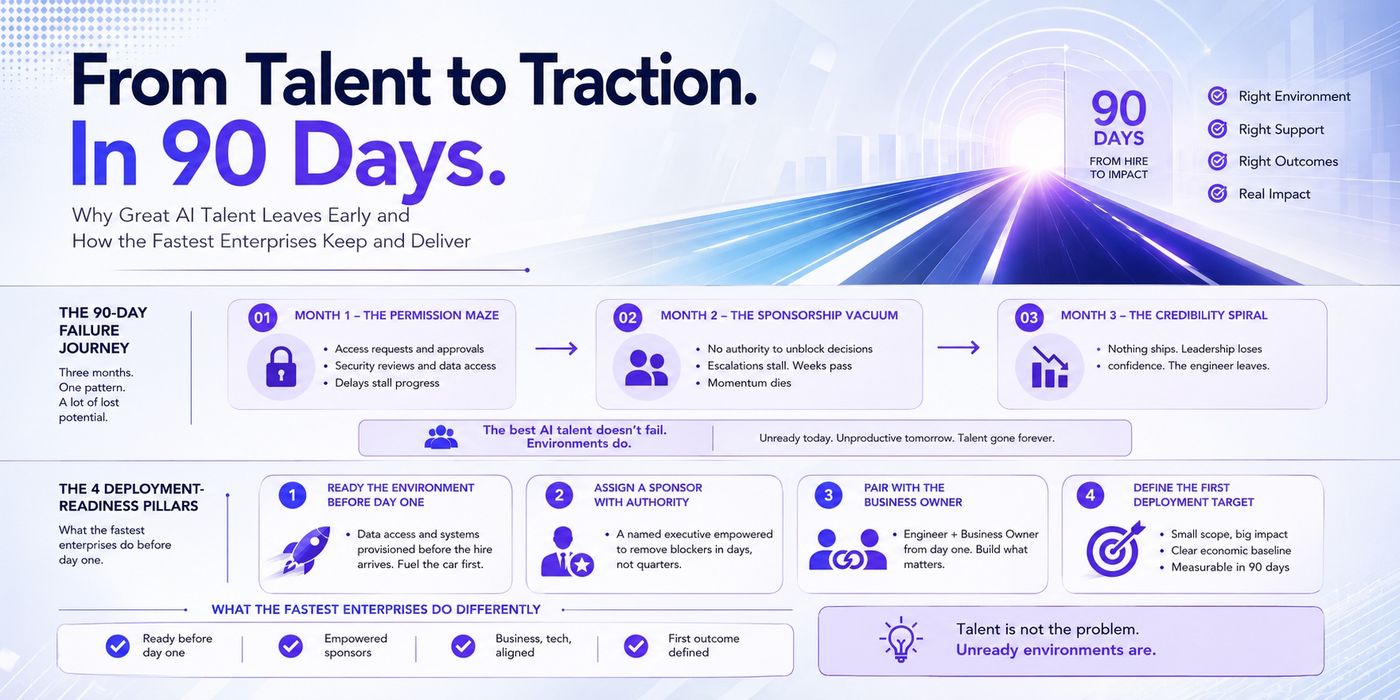
The Anatomy of the 90-Day Failure
The pattern is consistent enough that we can map it month by month.
Month one: the permission maze.
The engineer requests access to the data and systems the role obviously requires. Each request enters a queue owned by a function with no stake in the AI initiative’s timeline. Security review, data governance, vendor approvals, each individually reasonable, collectively a wall. The engineer, hired to deploy, becomes a full-time navigator of internal process.
Month two: the sponsorship vacuum.
The blockers that surfaced in month one require cross-functional decisions, data sharing between business units, workflow changes in an operating team, an exception to a procurement rule. These decisions need an executive sponsor with real authority. What the engineer usually finds instead is enthusiasm without authority: plenty of stakeholders who want AI, none empowered to clear its path. Escalations float. Weeks pass.
Month three: the credibility spiral.
Leadership, having paid a premium for the hire, starts asking what has shipped. The honest answer, nothing, because nothing could ship, lands as underperformance. The engineer is now defending a record that the environment, not the engineering, produced. The mutual conclusion forms quickly: this isn’t working. The resignation follows, and the organisational memory records it as a talent failure, guaranteeing the same mistake is repeated on the next hire.
Notice what is absent from all three months: any test of the engineer’s actual abilities. The hire failed without ever getting to perform. That is what makes this failure mode so expensive and so corrosive, it destroys premium-priced talent, executive confidence, and organisational belief in AI simultaneously, while teaching the enterprise exactly the wrong lesson.
What the Fastest Enterprises Do Differently
The enterprises converting pilots into production in 2026 treat onboarding AI talent as a deployment-readiness problem, not an HR process. The model has four components, and the first one begins before the hire’s start date.
1. Ready the environment before day one
Data access, system credentials, environment provisioning, and security pre-clearance are completed before the engineer arrives, treated as prerequisites of the hire, not tasks for the hire. The principle is simple: fuel the car before the driver shows up. Enterprises that do this convert the first week from a permissions queue into actual engineering. (The labs’ embedded-team model solved this by design: an embedded engineer arrives through a structured engagement that negotiates access as part of the contract, not after it.)
2. Assign a sponsor with authority, not enthusiasm
Every AI hire needs a named executive sponsor empowered to make cross-functional calls in days, not quarters, someone whose own scorecard includes the initiative’s deployment. The test is concrete: when the engineer hits a blocker that spans two functions, who resolves it this week? If the answer is a committee, the environment is not ready.
3. Pair with the business owner, not just the tech lead
The default enterprise instinct is to onboard AI talent into the engineering organisation. But deployment lives in business workflows, and the engineer’s most important early relationship is with the owner of the process being transformed, the person who knows where the workflow actually breaks, which exceptions matter, and what the operating team will and won’t absorb. Pairing FDE-grade talent with a business owner from week one is the single highest-leverage onboarding decision an enterprise can make.
4. Define the first deployment target, small, measurable, dated
The hire’s first ninety days should be anchored to one production deployment with a defined economic baseline: modest in scope, real in impact, measured against the metric agreed before work began. Not a roadmap, not a platform vision, not a pilot, a deployed system with a number attached. This gives the engineer a mandate, gives the sponsor a focal point for unblocking, and gives leadership evidence in one quarter instead of promises across four. Momentum in enterprise AI compounds from the first shipped outcome; the first ninety days exist to produce it.
Talent productivity is designed before day one or debugged after day ninety. There is no third option.
Where Aventiqo Operates
This is the problem Aventiqo’s engagement model was built to eliminate. We do not place talent into unready environments, because we have watched what unready environments do to it.
Every Aventiqo FDE engagement begins with a structured deployment-readiness phase executed before embedded delivery starts: data and system access negotiated and provisioned, an accountable executive sponsor named, business-owner pairing established, and a first deployment target defined against an explicit economic baseline. The engineer’s first week is spent engineering. That is the entire point of the model, and it is why our talent is productive from week one rather than resigning in week twelve.
For enterprises that have already experienced the 90-day failure, this is the difference between concluding “AI talent doesn’t work here” and discovering the talent was never the problem.
The Bottom Line
Early attrition of AI talent is the most preventable expensive failure in enterprise AI. The talent is not fragile; the environments are unready. Enterprises that fuel the car before the driver arrives, access provisioned, sponsor empowered, business owner paired, first outcome defined, keep the talent they fought to win and ship within the quarter. Everyone else keeps paying Formula 1 prices for engineers who never get to leave the paddock.
Next in this series: ”Measuring AI Teams: The Metrics Problem That Breaks Traditional Management”, why every legacy productivity metric fails for AI work, and what a board-ready measurement framework looks like.
About Aventiqo
Aventiqo is an AI services, solutions, and consulting firm that converts AI capability into deployed economic outcome. Our practice covers diagnostic, value-case design, embedded FDE delivery, workforce redesign, and measurement, executed under unified ownership.
Engage Aventiqo
Before your next AI hire starts, or your next initiative stalls – contact our team to schedule it. The deployment era rewards speed and discipline. Both compound from the first day of execution.