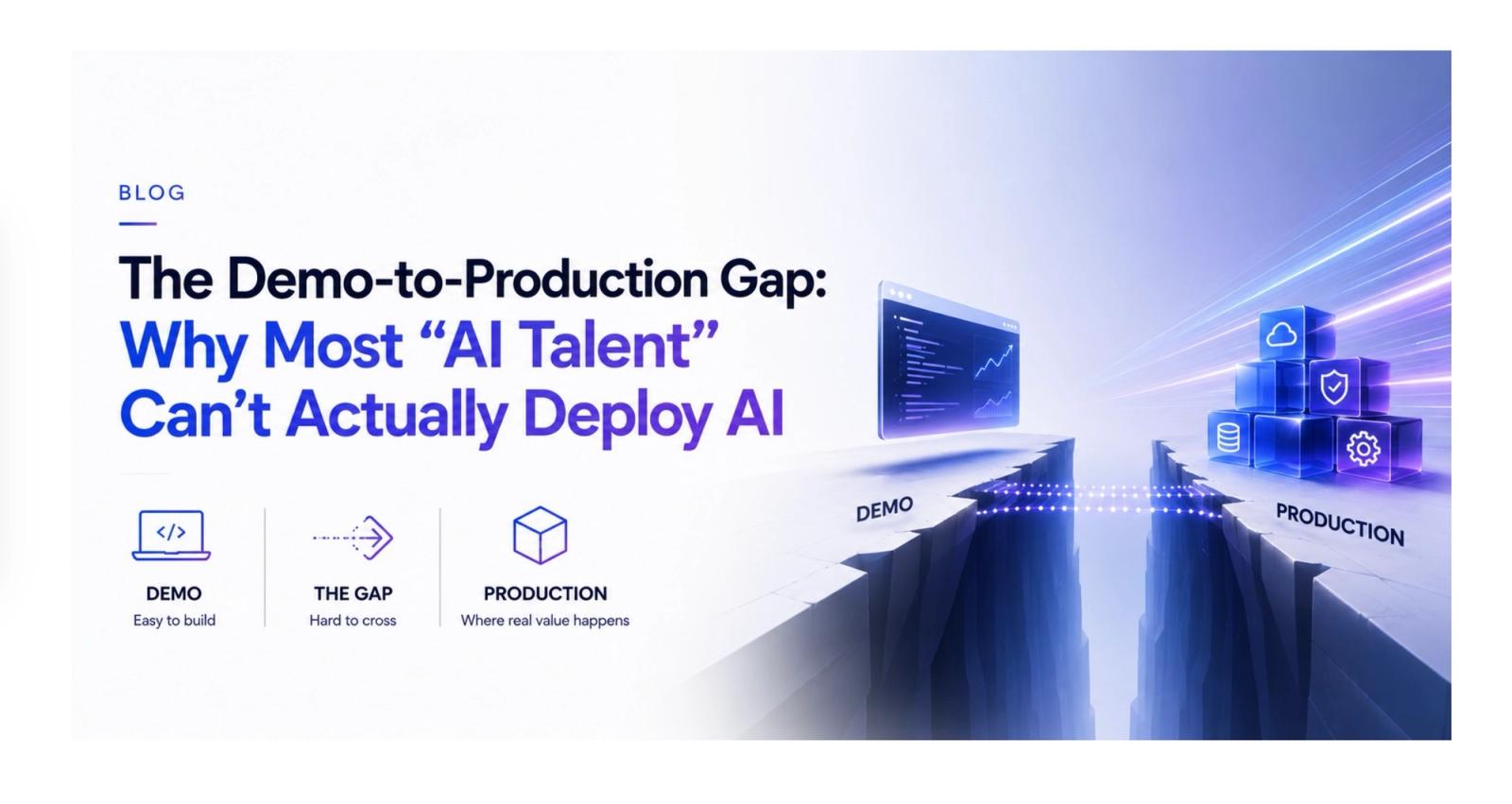
The Demo-to-Production Gap: Why Most “AI Talent” Can’t Actually Deploy AI
Aventiqo · The Human Layer of AI, Part 2 of 5
Gartner projects that at least 30% of generative AI projects will be abandoned after the pilot stage. The standard reading of that number blames the technology, the data, or the budget. We read it differently. Pilot purgatory is, at its root, a talent assessment failure: enterprises are hiring people who can build AI demos and discovering, six months and several million dollars later, that demos and deployments are different professions.
In Part 1 of this series, we examined why the market for deployment-grade AI talent is structurally lopsided. This post addresses the harder operational question: when that talent walks into your interview process, can you actually recognise it? For most enterprises today, the honest answer is no.
The Simplest Way to Understand the Gap
Building an AI demo is like cooking one excellent meal for friends. Running production AI is like running a restaurant.
The dinner party requires skill, no question. But the restaurant requires an entirely different set of capabilities: consistency at volume, supply chains, health inspections, staff who weren’t trained by you, customers who order things that aren’t on the menu, and the stamina to do it every single day, including the days when the freezer breaks.
The AI talent market is full of meal-cookers presenting themselves as restaurant-runners. Their résumés are genuinely impressive: models fine-tuned, prototypes shipped, hackathons won, pilots delivered. None of it tells you whether they can carry a system through security review, integrate it with a fifteen-year-old ERP, redesign the workflow of a team that didn’t ask for AI, survive three steering committees, and still hit a measured economic baseline.
The résumé shows the meal. The enterprise needs the restaurant. And the standard interview process cannot tell the difference.
Why Standard Interviews Select for the Wrong Profile
Most enterprise interview loops for AI roles were inherited from software engineering hiring, with a layer of ML vocabulary added. They test three things: algorithmic puzzles, model knowledge, and presentation polish. All three are weakly correlated, sometimes negatively correlated, with deployment capability.
Consider what each format actually rewards:
Whiteboard and algorithm roundsreward candidates who have optimised for interviews. The skills that make production AI succeed, navigating ambiguous requirements, making pragmatic trade-offs under legacy constraints, knowing when not to use a model, never appear on a whiteboard.
Model-knowledge rounds reward people who follow research. That is a fine trait, but a candidate can explain transformer architecture flawlessly and still have never moved a system past a Jupyter notebook. In 2026, model knowledge is abundant. Deployment scar tissue is not.
Demo and portfolio reviews reward exactly the demo-builders the process should screen out. A polished prototype proves the candidate can cook one meal. It says nothing about the restaurant.
The result is predictable. Enterprises run rigorous-feeling processes, hire confident candidates with strong portfolios, and then watch initiatives stall at the precise point where demo skills end and deployment skills begin. The pilot gets built. Production never arrives. Gartner’s 30% gets another data point.
What Deployment-Grade Talent Actually Looks Like
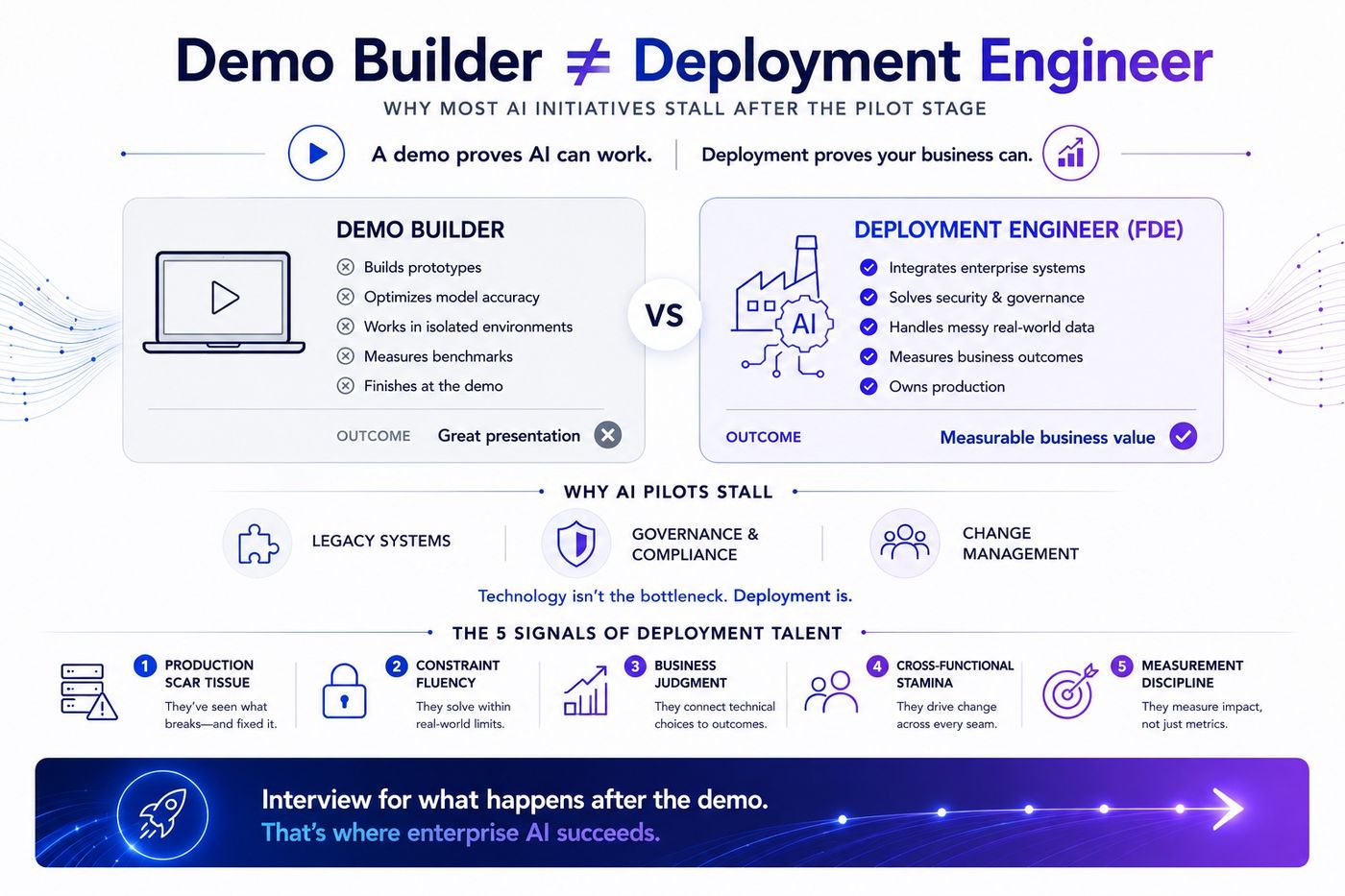
The frontier labs and FDE-native firms screen for a different profile. Having vetted and placed this talent class across enterprise environments, Aventiqo assesses against five signals that separate deployers from demo-builders. Leaders running their own hiring can apply the same lens.
1. Production scar tissue
Ask not “what did you build?” but “what broke after it shipped, and what did you do?” Deployers answer instantly and specifically: the data pipeline that silently degraded, the model that drifted after a business process changed, the integration that failed under real load. Demo-builders pivot back to the build story, because for them, shipping was the end of the story. For deployers, shipping is the midpoint.
2. Constraint fluency
Give candidates a deliberately imperfect scenario: legacy stack, incomplete data, a compliance requirement that rules out the elegant solution. Demo-builders treat constraints as obstacles to the right answer. Deployers treat constraints as the problem definition itself, and they start asking about your environment’s specifics within minutes, because that is where they live.
3. Business-judgment reflexes
Present a technical decision with an economic trade-off: a model that is 4% more accurate but triples inference cost and adds two months to integration. Deployment-grade talent reasons about the decision in business terms unprompted, payback period, workflow impact, what the accuracy delta is actually worth in the P&L. If the candidate cannot connect technical choices to economic outcomes, they will build technically correct systems that fail commercially.
4. Cross-functional stamina
Production AI dies in the seams between functions, security, legal, data owners, the operating teams whose workflows change. Probe for evidence the candidate has personally driven change across those seams: negotiated data access, redesigned a workflow with the team that owns it, carried an initiative through governance. This is the stamina the role demands, and it is the single most common gap in otherwise brilliant candidates.
5. Measurement discipline
The closing question that sorts the entire field: “How did you know your system worked?” Demo-builders answer in model metrics, accuracy, latency, benchmark scores. Deployers answer in baselines and outcomes: what the process cost before, what it cost after, how the delta was measured and attributed. The talent class that defines economic baselines before building is the talent class that escapes pilot purgatory.
Five signals, one pattern: deployers are defined by what happens after the demo. Interview for the after.
The Cost of Getting This Wrong
A mis-hire in a standard engineering role costs a salary and a backfill. A mis-hire in an AI deployment role costs the initiative. The pilot consumes its budget and its executive sponsorship, the abandonment becomes organisational evidence that “AI doesn’t work here,” and the next initiative starts from a credibility deficit. Multiply that across the portfolio and the assessment gap quietly becomes one of the largest unpriced risks in enterprise AI.
This is why assessment is not an HR detail. It is the control point that determines whether your AI investment compounds or evaporates.
Where Aventiqo Operates
Aventiqo built its talent pipeline around exactly this problem. Every engineer we place is vetted against deployment criteria, the five signals above, assessed through scenario-based evaluation against real enterprise constraints, not interview performance. We screen for production scar tissue, constraint fluency, business judgment, cross-functional stamina, and measurement discipline, because those are the traits our engagement model holds accountable: every Aventiqo FDE deploys against a defined economic baseline, through to measured P&L impact.
The result, for our clients, is that the demo-to-production gap is closed before day one, at the point of selection, where it is cheapest to close.
The Bottom Line
The 30% abandonment rate is not a technology verdict. It is the compounding cost of assessing AI talent with tools built for a different profession. Enterprises that learn to interview for the after, for what happens once the demo is over, will staff their AI portfolios with restaurant-runners. Everyone else will keep funding excellent meals that never become a business.
Next in this series: ”Why Your Best AI Hire Will Quit in 90 Days (And How the Fastest Enterprises Prevent It)”, why deployment-grade talent fails in unready environments, and the onboarding model that prevents it.
About Aventiqo
Aventiqo is an AI services, solutions, and consulting firm that converts AI capability into deployed economic outcome. Our practice covers diagnostic, value-case design, embedded FDE delivery, workforce redesign, and measurement, executed under unified ownership.
Engage Aventiqo
Hiring AI talent this quarter – contact our team to put vetted FDE / AI talent inside your environment. The deployment era rewards speed and discipline. Both compound from the first day of execution.